“Maybe the journey isn’t about becoming anything. Maybe it’s about unbecoming everything that isn’t really you, so that you can be who you were meant to be in the first place.”
Paulo Coelho
When I lost my job of nearly 20 years, almost two years ago, I didn’t immediately know what I wanted to do next. I pursued three things in parallel: investing in a short-term rental as a hedge against an uncertain economy and future, looking for work to make ends meet, and thinking about what consulting might look like after two decades in professional audio and brand leadership.
Nearly 19 months later, the rental has been purchased, renovated, and launched. The job search hasn’t led to sustainable work. Multiple applications have earned me one interview.
Meanwhile, I’ve started or co-founded three businesses.
So what do I take from that?
At least in my experience, it has been substantially easier to start a business than to get a job. That doesn’t mean I’ve figured out how to grow revenue enough to sustain a six-figure salary. It means I’ve found more traction, and more meaning, in building something than in the job search.
AI is part of both sides of that story. It’s contributing to real job losses and adding noise to an already difficult hiring process. At the same time, it’s making some of the tools and capabilities needed to start a business more accessible. In the current economy, AI can make work less secure while making entrepreneurship more possible. That’s what I’ve experienced.
The more investor capital I watched flow toward technology that is credibly eroding jobs and job stability, the more I wanted to protect myself by building somewhere different. My problem isn’t with individual investors or firms. It’s with the combination of wealth hoarding and wealth funneled into things that either hurt the average person or don’t help them. When profits and exits take priority over people, something is out of balance.
I’m not opposed to AI. It’s a mixed bag: it empowers some people as much as it puts others out of work. But entire livelihoods are being disrupted, and the people paying the price aren’t the investors funding AI’s development. I’m uncomfortable with a race in which that disruption can be treated as a cost of doing business, while the financial upside is concentrated elsewhere.
Coming from product ideation and startup founding, I’ve always thought differentiation mattered. Founders and product people look for unmet or underserved needs. They try to go where the crowd isn’t.
So when so many investors and founders were racing toward the same AI bets, I started asking myself: why keep trying to get a traditional job when I could build something of my own?
I wanted work I could stand behind: grounded in real experience, useful to people, and in a space that felt more defensible against AI. For me, that meant work tied to physical property, local knowledge, firsthand operating experience, hosting humans, and enabling experiences.
I didn’t expect that work to be short-term-rental acquisition and launch consulting. I thought consulting would grow out of my two decades of professional audio and brand leadership. Instead, it slowly shifted toward vacation rentals.
As I looked into the help available for people trying to get into the short-term-rental business, the options I kept encountering were largely do-it-yourself or a large upfront fee paired with a long-term subscription. I saw room to offer a different kind of help, based on having done the work myself and without building the service around a subscription or an eventual exit.
I was struck by how often business solutions seemed designed around recurring revenue and investor returns, rather than improving customers’ lives. I wanted to try something else: help people make a major decision and launch successfully, then let them choose the ongoing support that fits them.
I also know the ethics aren’t simple. Critics of short-term rentals could say I’m making a smaller version of the same bet: investing in something whose value depends on customers continuing to want it, while holding out for a successful exit someday.
They’re not entirely wrong.
Over these past 19 months, it has been easier for me to start or co-found businesses and launch a vacation rental than to get a part-time job. That’s my individual experience, not a universal claim. But it says something about the job market and the choices people are weighing.
The consulting work has taken another unexpected turn. I’ve started introducing it to Realtors in vacation-home markets. So far, they seem genuinely excited to have an STR expert on their team, not only because I can help them sell houses, but because their clients ask about rental demand, permitting, and property management, where firsthand experience can help.
That feels like a good fit. I’m excited to move from zero to one, even if it’s in an industry I didn’t expect to enter. I wake up knowing I’m my own boss, and that my customers are on an exciting journey of their own.
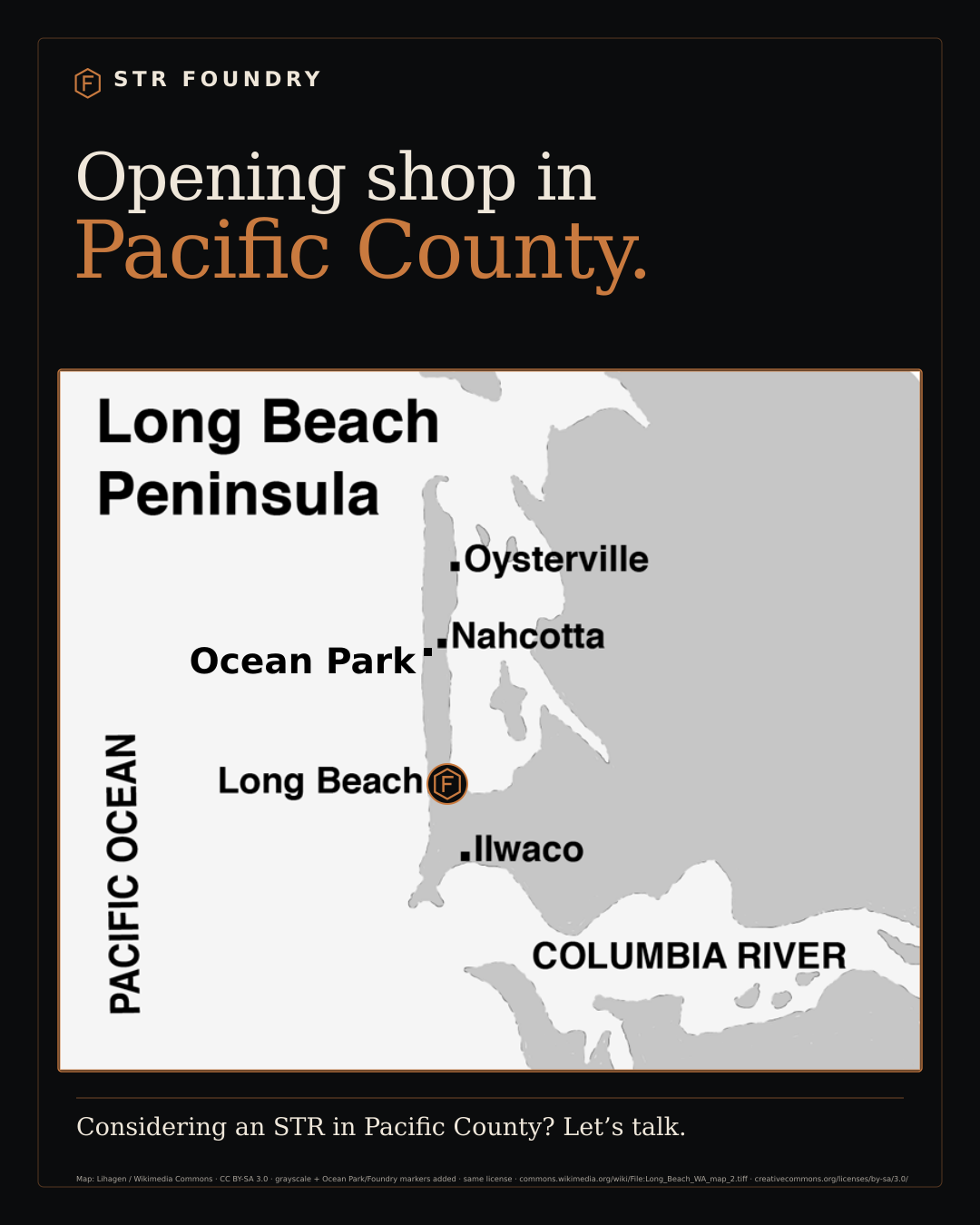
And that’s specifically why I’m starting STR Foundry in Pacific County. I can even walk you through the research that led me there.
If you’re looking to own a vacation rental on the Long Beach Peninsula, or looking elsewhere and curious how this market compares, I’m intimately familiar with what you’ll need to navigate to set up successfully.
Feel free to reach out at matt@strfoundry.com, or send me a message on LinkedIn to start a conversation.